

The most common cause of a bad website in Kenya is not a bad designer. It is a bad brief — or no brief at all. When a client sends a WhatsApp message saying “I need a website for my business, how much?” and a designer responds with a price, what has actually happened is that both parties have begun a project with different mental pictures of what it will look like, what it will do, and what success means. The resulting site almost always disappoints at least one of them.
A web design brief is a document — it does not need to be long or formal — that answers the questions a designer needs to answer before they can produce accurate work. It is the bridge between what you want and what you will receive. Businesses that commission websites without one are, without exception, paying more than they need to and revising more than they should.
A vague brief gets you wildly inconsistent quotes, a designer who built the wrong thing, and an invoice that grows larger every week. A specific brief gets you accurate numbers, fewer surprises, and a site that does what you actually need.
Why most Kenyan web projects fail before they start
Kenya’s web design market has a specific communication problem. Most clients — particularly first-time website commissioners who are running a business and have no technical background — approach a designer the same way they would approach a carpenter or a tailor. They describe what they want verbally, assume the professional will interpret it correctly, and expect the result to match their vision without extensive documentation.
This works for a suit or a bookshelf because those are physical objects with well-understood constraints. A website is neither physical nor well-understood. The same description — “a professional website for my consultancy” — could produce a five-page WordPress site for KES 45,000, a custom-designed brand platform for KES 220,000, or an elaborate portfolio site with client portals for KES 400,000. Without a brief, you will likely receive proposals for all three, in a range so wide it is useless for decision-making.
The brief solves this by converting a mental image into a shared document. Once both parties are working from the same written description of the project, quotes become comparable, revisions become manageable, and disputes become rare. It takes two to four hours to write a good brief. That investment consistently saves weeks of back-and-forth and tens of thousands of shillings in rework.
What a brief is not
Before covering what to include, it is worth clearing up two common misconceptions.
A brief is not a technical specification. You do not need to know what PHP version to use, which hosting provider is best, or how the database should be structured. That is the designer’s domain. The brief covers the business side: goals, audience, pages, functionality, budget, and timeline. Trying to include technical requirements you do not understand will not make your brief more useful — it will make it confusing.
A brief is not a contract. The brief initiates the conversation and enables accurate proposals. The contract — which should always exist separately — governs the legal relationship, payment terms, intellectual property, and dispute resolution. A brief and a contract serve different purposes and both are necessary. See our guide to hiring a web designer in Kenya for the full contract checklist.
Some online tools market themselves as a website design brief generator — tools that ask you a series of questions and produce a formatted document automatically. These can be a useful starting point, particularly for first-time clients, but the outputs often lack the Kenya-specific context that makes a brief genuinely useful to a local designer. The template at the end of this article is designed specifically for the Kenyan market.
The eight sections every brief needs
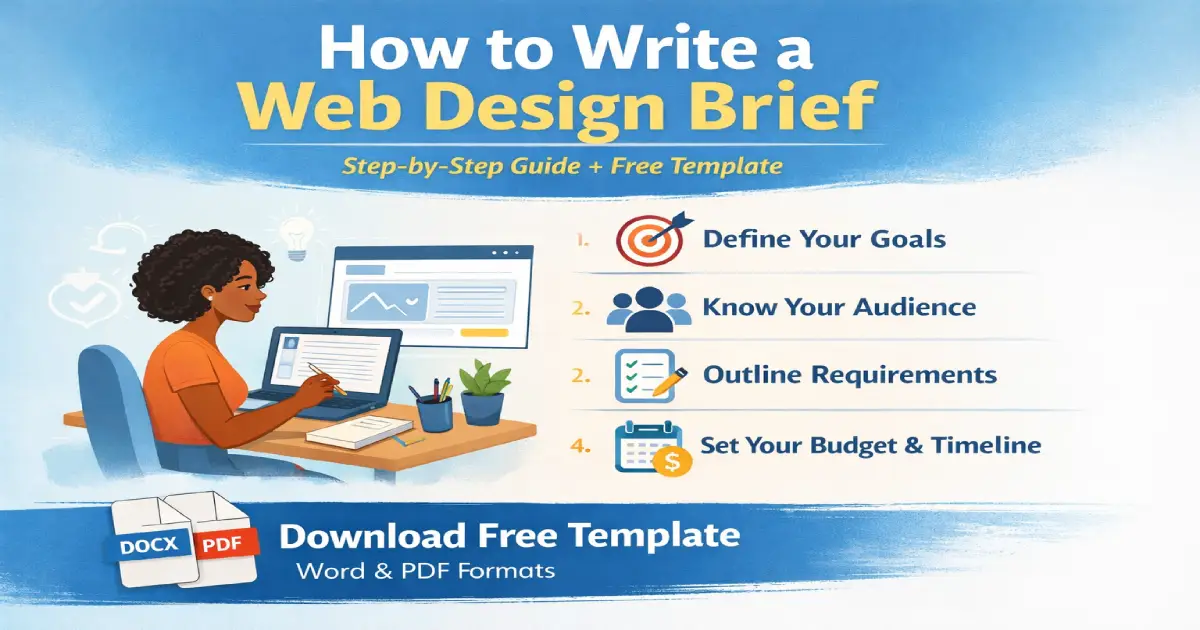
A complete web design brief covers eight areas. None of them require technical knowledge — only honest answers about your business. Here is each section explained, with the distinction between answers that help a designer and answers that produce confusion.
Business context
This is where you introduce yourself — but not in the way you would on a CV. A designer needs to understand what your business does, who it does it for, and what makes it different from competitors. This is not a marketing exercise. It is the information a designer needs to make visual and structural decisions that reflect your actual business rather than a generic template.
Include: your business name, location, core service or product, the type of customer you serve (industry, size, geography), and what sets you apart from competitors. If you have an existing brand — logo, colour palette, fonts — note it here and attach the files separately.
Project purpose and primary goal
Every website has one primary purpose, even if it also serves secondary purposes. Defining that primary purpose shapes every structural and visual decision the designer will make. The most common primary purposes in the Kenyan market are:
- Lead generation — the site exists to produce phone calls, WhatsApp enquiries, or contact form submissions
- Direct sales — the site takes orders and processes M-Pesa or card payments
- Credibility building — the site supports face-to-face sales by giving prospects somewhere to verify the business is real and professional
- Information delivery — an NGO donor portal, a government service page, or an educational resource
- Recruitment — the site’s primary job is to attract job applicants
Your target audience
This is the section most Kenyan business owners write too generally. “Our audience is Kenyan adults aged 18 to 60” describes approximately 24 million people and gives a designer no useful information. The more specific you can be, the more accurately the designer can make structural, visual, and content decisions.
Describe your primary customer by: their approximate age and gender (if relevant), what they do professionally, where they are located in Kenya, what device they most likely use to browse (phone — Android or iOS — or desktop), what language they prefer, and what they need to see or read to decide to contact you. If you have existing customers, describe a real one.
Pages and site structure
List every page the site needs, with a one-sentence description of what each page must accomplish. This is the single most valuable section for producing accurate quotes. Two sites described as “a business website” can have entirely different page counts — and a KES 40,000 difference in price — based on structure alone.
Common page structures for Kenyan business websites as website brief examples:
- Minimal (5 pages): Home, About, Services, Gallery/Portfolio, Contact — suitable for a salon, sole trader, or local service business
- Standard (7–10 pages): Adds individual service landing pages, a Blog/Resources section, and a Testimonials or Case Studies page — for SMEs actively seeking leads online
- E-commerce: All of the above plus Shop, individual Product pages, Cart, Checkout with M-Pesa, Order Confirmation, and My Account — a fundamentally different scope
- NGO/institutional: Home, About, Programmes, Impact/Reports, Donate, Partners, News, Contact — plus potentially a restricted donor login area
Key functionality and integrations
Functionality is what separates a brochure from a tool. Every function you add — M-Pesa checkout, booking calendar, live chat, member login, PDF downloads — adds development time and therefore cost. Listing them in the brief gives the designer what they need to quote accurately and flag technical dependencies you may not have considered.
For Kenyan businesses specifically, note whether you need: M-Pesa Daraja API integration (and whether you already have a paybill or till number), a WhatsApp chat button, Google Maps embed, Swahili language support, an SMS notification system, or integration with any existing software your business uses (accounting, CRM, or inventory).
Design direction and reference sites
You do not need design expertise to complete this section. You need three things: your existing brand assets, a description of how you want visitors to feel when they land on your site, and two or three existing websites whose visual style you find appealing — ideally with a note on what specifically you like about each one.
The “how you want visitors to feel” question is more useful than it sounds. “Professional and trustworthy” produces a different result than “modern and approachable” which produces a different result than “premium and exclusive.” These are genuinely different design directions, not variations on the same thing.
“We want visitors to feel reassured and confident that we are serious professionals. Not intimidating or cold — approachable but clearly expert. We like the structure of Bowmans Kenya’s website (clean, clear navigation, prominent partner profiles) and the warmth of Africa Practice’s homepage photography. We dislike overly dark colour schemes and sites heavy with stock photos of gavels and courthouses.”
This gives a designer an unambiguous direction, two concrete reference points, and two explicit constraints. It can be written in five minutes and saves hours of revision.
Attach your logo files in vector format (AI, EPS, or SVG) and any existing brand colour codes. If you are starting from scratch with no existing brand, note that — it changes the project scope because the designer will need to establish visual identity before designing pages.
Budget — state a real number
This is the section most Kenyan business owners skip or misrepresent. The reasoning is usually one of two things: they do not want to “tip their hand” and receive a quote that conveniently matches their stated maximum, or they genuinely do not know what the work should cost and are hoping a quote will tell them.
Both of these reasons, while understandable, produce worse outcomes than stating a real budget. Here is why:
When a designer receives a brief with no budget, they cannot tailor the proposal. They will either quote what they think the work is worth (which may be far outside your range), quote a low number to win the project and expand scope later, or ask you to fill in the gap before they can proceed — adding a round-trip delay. When a designer receives a specific budget, they can immediately tell you what is achievable at that figure and what trade-offs are required. This is the information you actually need.
State a range — for example “KES 80,000–120,000” — rather than a single figure. This gives a designer room to show you what is possible at different points in that range without anchoring them to a floor price. For current market rate guidance, see our website cost Kenya guide.
Timeline and launch requirements
State when you need the site live and, critically, why. “Before our product launch on 15 June” is a different constraint than “before the end of Q2” which is different again from “no specific deadline.” Each carries different implications for a designer’s scheduling and, in some cases, their quoted price — rush work typically costs more.
Also flag anything that could delay your side of the project. If you do not have professional photography yet, note it — and by when you will have it. If you need internal sign-off from a board or partner before approving designs, build that into the timeline estimate. Content delays from the client side are the most common cause of project overruns in Kenya. Being honest about this in the brief is the single most effective way to prevent it.
A complete Kenya-specific brief example
The following is a complete website design brief written in the format recommended by this guide. It is for a fictional business — a Nairobi-based catering company — but represents the level of detail that produces accurate proposals and avoids revision cycles. This is the kind of detailed website brief example that a designer anywhere in Kenya can act on immediately.
Business context: Zawadi Catering is a Nairobi-based corporate catering company operating since 2019. We serve corporate clients — companies with 20 to 200 employees — in Westlands, Upperhill, and Kilimani. We provide breakfast, lunch, and event catering. Our differentiator is a full dietary options menu (halal, vegan, gluten-free) that competitors do not offer. Current clients include several NGOs and two mid-size law firms. Existing branding: logo (vector), primary colour cobalt blue (#1A4FA8), accent gold (#F4B940).
Project purpose: Lead generation. The site’s primary job is to produce enquiry calls or WhatsApp messages from HR managers and office administrators at Nairobi corporates. Secondary: credibility building for prospects who Google us after a referral.
Target audience: HR managers and office managers, predominantly female, 28–45, working in Westlands and Upperhill corporate offices. Browse on phone (Android) during work hours. Decision-makers with a budget to spend, but accountable to a CFO — they need to justify the choice. Trust signals: client logos, certifications, and specific menu samples are more convincing than generic photography.
Pages required: Home (hero image, 3 service types, prominent WhatsApp CTA); About Us (team photo, founding story, values, dietary certifications); Services — Corporate Lunches, Event Catering, Breakfast Packages (three separate pages); Gallery (photo grid, filterable by event type); Testimonials; Contact (form + WhatsApp + phone, embedded Google Map to our kitchen in Westlands).
Functionality: WhatsApp click-to-chat button pinned to bottom-right on all pages; contact form that emails submissions to zawadi@zawadi.co.ke; Google Analytics tracking; no e-commerce at this stage — M-Pesa checkout possible in Phase 2.
Design direction: Professional, warm, and food-forward. We want photography to lead — real food, real people, not stock images. Reference: Urban Gourmet’s website (structure and warmth); The Boma Hotel’s menu presentation. Avoid: dark backgrounds, overly minimal layouts that downplay the food.
Budget: KES 85,000–130,000 including photography direction (we have a photographer — designer provides shot list).
Timeline: Live by 30 June 2026. We have a corporate networking event on 5 July and want to hand out business cards with the site URL. Photography available from 10 May. Internal sign-off from two partners — allow 5 business days per review round.
Notice that this brief does not contain a single technical requirement. It contains business context, specific audience description, clear goal, page-level function descriptions, explicit design preferences with reference sites, a real budget range, and a deadline with an explanation. A competent designer reading this can produce an accurate proposal within 48 hours.
The UX Potential brief template — free download
The template below is the exact structure we recommend to every business that uses this directory to find a designer. Fill it in section by section — it takes two to four hours for a first-time user — and attach it to any designer outreach. Designers who receive it will quote more accurately and with more confidence. Those who struggle to respond to it in any useful way are self-selecting out of your shortlist.
This template works whether you are commissioning a simple five-page brochure site or a complex e-commerce platform. The sections are the same — only the depth of your answers changes. It can be used as a website design brief template Word document, a fillable PDF, or simply copied into a Google Doc. The structure is what matters, not the format.
UX Potential — Web Design Brief Template
Fill in every section. Leave nothing blank — write “not applicable” or “to be confirmed” rather than skipping. Attach logo files, any brand guidelines, and reference site URLs as separate items.
The downloadable website design brief PDF and Word formats of this template are pre-formatted with section headers, prompt text, and example answers that you can replace with your own content. The Word version is editable for those who prefer working in a design brief template Word document; the PDF version is better for sharing with designers as a fixed-format attachment.
The downloadable website design brief PDF and Word formats of this template are pre-formatted with section headers, prompt text, and example answers that you can replace with your own content. The Word version is editable for those who prefer working in a design brief template Word document; the PDF version is better for sharing with designers as a fixed-format attachment.
The downloadable website design brief PDF and Word formats of this template are pre-formatted with section headers, prompt text, and example answers that you can replace with your own content. The Word version is editable for those who prefer working in a design brief template Word document; the PDF version is better for sharing with designers as a fixed-format attachment.
Five brief-writing mistakes that cost Kenyan businesses money
1. Writing the brief after getting quotes
Some business owners get a verbal quote first, then write the brief. This reverses the process. A quote without a brief is an estimate based on assumptions. Write the brief first, then circulate it to your shortlisted designers simultaneously. This is the only way to receive comparable proposals.
2. Treating the brief as a wish list rather than a decision
A brief that lists “nice to have” features alongside “must have” features without distinguishing them forces the designer to include everything. Separate your requirements explicitly: must-have for launch, and nice-to-have for a potential Phase 2. This gives the designer a clear scope to quote against and reduces the risk of scope creep once the project starts.
3. Omitting the M-Pesa prerequisite check
Many Kenyan businesses assume that requesting M-Pesa integration is sufficient for a designer to implement it. It is not. You need a registered Safaricom paybill or till number before the integration can be built and tested. If you include M-Pesa in your brief without confirming you have a registered paybill, the designer will build to a placeholder and wait — adding weeks to the timeline. Resolve this before the brief goes out.
4. Providing no visual direction
Designers are not mind readers, and “professional” means something different to a tax consultant than it does to a streetwear brand. If you skip Section 6 of the brief, you will receive a design that reflects the designer’s interpretation of “professional” — which may or may not match yours. The two reference sites and the “what to avoid” note take ten minutes to write and prevent the most common cause of expensive design revisions.
5. Expecting the brief to replace conversation
The brief enables conversation — it does not replace it. After sending a brief, expect and welcome a designer who asks clarifying questions. A designer who reads a detailed brief and asks nothing before quoting has either not read it carefully or is overconfident. The questions a designer asks after reading your brief tell you as much about their quality as their portfolio does.
What happens after you send the brief
Send the brief to three to five candidates simultaneously — not sequentially. Give each of them the same document. Ask for a written proposal within five to seven business days. A proposal should include: a specific price tied to specific deliverables, a payment schedule, a proposed timeline, and a note on what is and is not included.
When you compare proposals, do not compare prices directly. Compare what each price covers. One designer’s KES 95,000 may include photography direction, copywriting review, Google Search Console setup, and a 30-day support window. Another’s KES 95,000 may cover design and development only, with everything else charged separately. The brief you wrote becomes the evaluation framework: score each proposal against your stated requirements, not against each other’s prices.
Leave a Comment