


Aesthetics vs ROI: reframing what “good” means

There is a recurring conversation that happens across design briefings in Nairobi, Mombasa, and Kisumu. A business owner meets a web designer, pulls up a competitor’s site — usually a foreign brand — and says: “I want something that looks like that.”
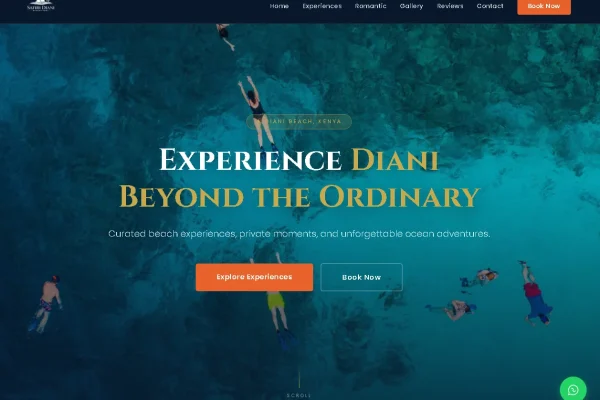
The designer, eager to please, delivers a pixel-perfect reproduction of that visual aesthetic. It has full-bleed video, elegant serif fonts, smooth scroll animations, and a hero image compressed at exactly the wrong file size for a 3G connection. The client is delighted. Their customers bounce off it in under four seconds.
The problem is not the designer. The problem is that the brief was wrong.
A beautiful website that does not load on a Safaricom 3G connection is not a good website. It is an expensive mistake with a polished surface.
The right definition of a good website in the Kenyan context is one that: loads fast on the devices your customers actually own, communicates your value in the time your customer is willing to give you, earns their trust in a market where digital fraud remains a real concern, and guides them toward a specific action — a call, a form submission, an M-Pesa payment.
That is five things. They map almost exactly to the five pillars below.
Clarity above all else
You have approximately five seconds. That is not a metaphor or a marketing cliché — it is a measurable behavioural window. Research consistently shows that users decide whether to stay or leave a webpage within the first five seconds of arrival. For a Kenyan user on mobile data, that window may be shorter, because slow loads eat into it before any content appears.
In those five seconds, your homepage must answer three questions without making the user think:
- What do you do? — stated plainly, in one sentence, using the words your customers use.
- Who is this for? — a business in Westlands is not the same customer as a family in Kasarani. Do not write for both simultaneously.
- What should I do next? — one clear, visible call to action.
Run the 5-second test on your own site right now
Open your homepage on your phone. Start a five-second countdown. Then close it. Ask yourself:
- Could you state in one sentence what that business does?
- Did you see a single obvious next action?
- Did the page feel like it was talking to you specifically?
If any answer is no, your homepage has a clarity problem — regardless of how attractive it is.
The most common clarity failure we see in Kenyan business websites is the vague tagline. Phrases like “Your trusted digital partner” or “Excellence in service delivery” communicate nothing. They are placeholders that feel professional while being functionally empty. Replace them with specificity. “Affordable website design for Nairobi small businesses, delivered in 14 days” is longer, less elegant, and infinitely more effective.
The second most common failure is the buried call to action. A phone number in the footer, accessible only after the user has scrolled through five sections, is not a call to action. It is an obstacle. Your most important action — WhatsApp, call, book, buy — should be visible without scrolling on every device.
Fast loading speeds
This is where the Kenyan context diverges most sharply from global web design wisdom — and where the most expensive mistakes are made when a business hires a designer unfamiliar with local infrastructure.
Let those numbers sit for a moment. More than half of your potential customers — the ones who could not wait three seconds — never saw your content, never read your prices, never found your phone number. They bounced before you had a chance to speak to them.
The practical implication for Kenyan websites is aggressive performance engineering, not decoration. Here is what that looks like in practice:
Bounce rate probability by load time (Google Research)
What does a “fast” Kenyan website look like technically? The target is under three seconds on a 4G connection and under six seconds on 3G. Achieving this requires:
- WebP image format instead of PNG or uncompressed JPG — typically 30–50% smaller at equivalent quality
- Lazy loading for images below the fold — the browser only loads what the user is about to see
- No bloated page builders — popular drag-and-drop tools like Elementor or Divi often inject 300–500KB of unused CSS and JavaScript that loads before your content appears
- Kenyan or African server hosting — a site hosted in Frankfurt or Virginia adds 150–300ms of latency per request purely due to geography
- Minimal third-party scripts — every Google Font, chat widget, and analytics pixel is an additional HTTP request that blocks rendering
A skilled local designer will know these optimisations instinctively and apply them without being asked. An offshore developer defaults to what they know — which is often a Western framework optimised for 100Mbps fibre connections.
Seamless navigation
There is a design principle called the “don’t make me think” rule, coined by UX researcher Steve Krug. It holds that every moment a user is forced to consciously think about how to navigate your site is a moment where you are losing them. Navigation should feel invisible — so intuitive that the user has already found what they wanted before they noticed they were looking.
In the Kenyan context, this principle has a specific physical dimension that Western UX research underweights: thumb zones on mobile.
Most Kenyan mobile users hold their phones with one hand and navigate with their thumb. This means the top third of the screen — where most hamburger menus and navigation links live — is the hardest to reach. Important actions buried in a top navigation require a two-step interaction: tap the menu icon, then tap the destination link. Each additional tap is friction. Each friction is a percentage point of conversions lost.
Good navigation for a Kenyan mobile audience means:
- A sticky WhatsApp button in the lower-right corner — visible on every page, always within thumb reach
- A maximum of five primary navigation items, with clear, descriptive labels (not clever ones)
- Tap targets of at least 48×48 pixels — the minimum Google recommends for mobile usability
- A single, prominent call to action on every key page — not five competing buttons of equal visual weight
- Search functionality if the site has more than 20 pages of content
The underlying rule: every additional decision you ask the user to make reduces the probability that they make the decision you want them to make.
Trust signals for a Kenyan audience
This is the pillar most frequently underestimated by designers who have not built extensively for East African markets — and the one that, when absent, silently kills websites that look objectively beautiful.
Kenya’s digital commerce market is still building its trust infrastructure. Online fraud, fake listings, advance-fee scams, and ghost businesses that take deposits and disappear have made Kenyan consumers — justifiably — cautious about transacting with businesses they cannot verify. Your website must proactively address this scepticism. Waiting for customers to “just trust you” is not a strategy.
One trust signal deserves special attention: WhatsApp as primary contact. In the Kenyan market, WhatsApp is not just a messaging platform — it is the default business communication channel for most SME transactions. A business that has a contact form but no WhatsApp button signals — consciously or not — that it is harder to reach and perhaps less responsive than a competitor who has the green button visible on every page. When in doubt, show the WhatsApp button first.
The best trust signal is not a certificate or a logo. It is evidence that a real person is waiting to hear from a real customer.
Mobile optimisation
We have touched on mobile throughout every other pillar because in Kenya, mobile is not a variant of the web experience — it is the web experience. But mobile optimisation deserves its own pillar because it is frequently misunderstood, even by web designers who claim to do it.
“Mobile responsive” and “mobile optimised” are not the same thing.
Mobile responsive means the layout reflows when the screen size changes. It is the baseline minimum — a technical checkbox most modern websites pass automatically. Your WordPress theme does this by default.
Mobile optimised means the entire design was conceived with mobile as the primary context. The typography was set for a 375px screen before it was scaled up for desktop. Images were compressed for data-constrained connections. Touch targets were sized for thumbs. Forms were simplified to reduce typing. The checkout flow was designed for M-Pesa, not a credit card form with 16 fields.
When briefing a designer, the single most important question to ask is: “Will you design this mobile-first?” A designer who hesitates or responds with “don’t worry, it will be responsive” has told you everything you need to know. Responsive is not mobile-first. Read our detailed guide to mobile-first development to understand the full technical and design implications.
The good news: mobile-first design is not more expensive. It often costs less, because it forces a discipline of simplicity that produces leaner, faster, more maintainable code. The problem is that it requires a designer who has internalised the constraint as a default, not as an afterthought.
The 15-minute self-audit: score your website right now
Print this checklist. Open your current website on your phone — not your laptop — and go through it honestly. One point per item.
What your score means
12–15: Your website is working for you. Focus on content and SEO to drive traffic.
8–11: Your website has real gaps — some customers are falling through. Prioritise the items you missed in Pillars 2 and 4 first.
Below 8: Your website is likely costing you customers every week. A rebuild with a locally experienced designer is worth serious consideration.

Leave a Comment